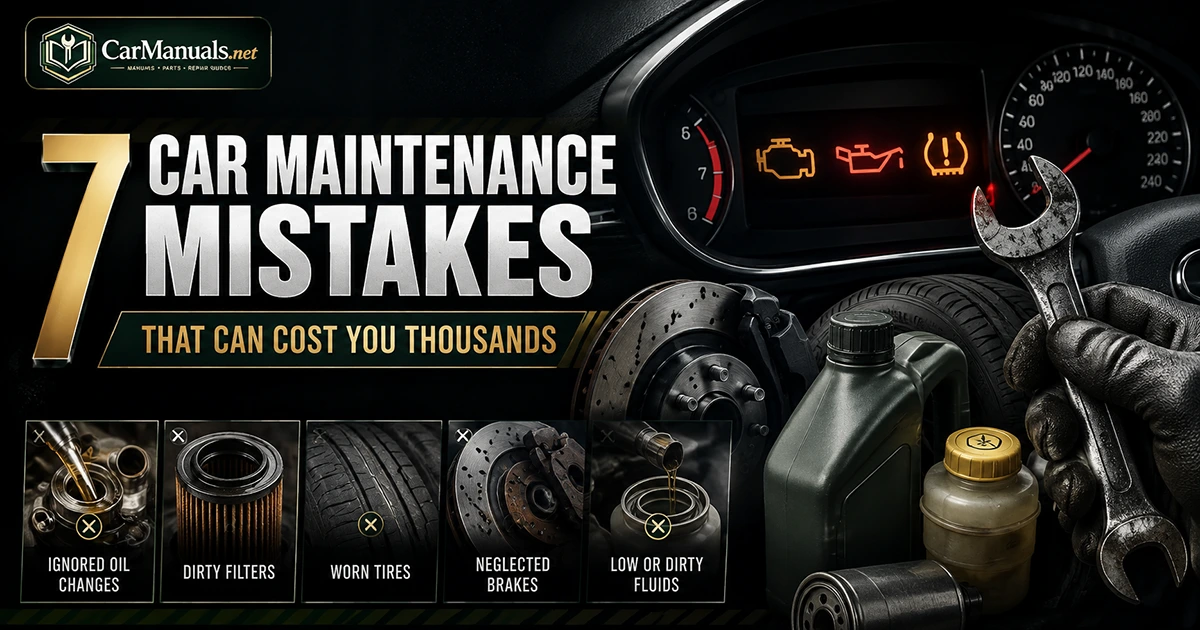
7 Car Maintenance Mistakes That Can Cost You Thousands
Most expensive vehicle repairs do not begin with one catastrophic mistake. They start with a series of small maintenance decisions that are easy to ignore: stretching an oil change, driving for weeks with a warning light, postponing brake service, or assuming a fluid is good for the life of the vehicle.
Those decisions may not cause an immediate breakdown, which is exactly why they are dangerous. Wear builds gradually until a relatively inexpensive maintenance job turns into a major repair.
Below are seven of the most common car maintenance mistakes, why they matter, what they can eventually cost, and how to avoid them without obsessing over your vehicle.
1. Waiting Too Long Between Oil Changes
Engine oil does far more than lubricate moving parts. It also helps control heat, suspend contaminants, reduce corrosion, and protect precision surfaces inside the engine.
As oil ages, its additive package gradually depletes. Contamination can increase, viscosity can change, and deposits may begin forming in areas where clean oil needs to circulate freely.
Repeatedly stretching oil changes far beyond the manufacturer’s recommendation can contribute to sludge, accelerated timing-component wear, damaged bearings, oil-control problems, and eventually engine failure.
What it can cost: Routine oil service is usually inexpensive compared with repairing or replacing an engine, which can easily become a several-thousand-dollar job.
What to do instead: Follow the interval specified by the vehicle manufacturer or the vehicle’s oil-life monitoring system. Do not assume every car should be serviced at the same mileage.
Pay particular attention to the manufacturer’s definition of severe service. Frequent short trips, extensive idling, towing, extreme temperatures, dusty environments, and repeated stop-and-go driving may require more frequent maintenance.
If you are unsure what your vehicle requires, start with the CarManuals.net repair manual resources or free manual sources.
2. Ignoring Tire Pressure Until the Warning Light Appears
The tire-pressure monitoring system is a safety feature, but it should not be treated as your normal tire-pressure gauge.
A tire can be below the vehicle manufacturer’s recommended pressure before the warning becomes obvious to the driver. Underinflation can increase tire heat, worsen handling, increase rolling resistance, and cause uneven or accelerated tread wear.
Overinflation can also reduce the tire’s ability to maintain proper contact with the road and may contribute to irregular wear.
What it can cost: Poor inflation can shorten tire life, reduce efficiency, and potentially contribute to a tire failure. Replacing tires prematurely can cost hundreds of dollars.
What to do instead: Check tire pressure approximately once a month and before long trips. Check the tires when they are cold whenever possible.
Use the pressure listed on the vehicle’s tire-information placard, normally located on the driver’s door jamb or door opening.
Do not inflate the tires based on the maximum pressure molded into the tire sidewall. That number describes the tire’s maximum rated pressure under specified conditions; it is not necessarily the recommended pressure for your particular vehicle.
3. Treating Dashboard Warning Lights Like Suggestions
A warning light tells you that a vehicle system has detected something outside its expected operating range. It does not automatically tell you whether the problem is inexpensive or serious.
A check-engine light, for example, might be associated with something relatively simple, but it can also indicate a misfire, fuel-control problem, emissions-system failure, sensor fault, or another condition that should be diagnosed.
The important distinction is between a steady check-engine light and a flashing one. A flashing malfunction indicator can indicate an active problem serious enough that continuing to drive may cause additional damage. Consult the owner’s manual and address it immediately.
What it can cost: Ignoring an underlying engine problem can allow one failed component to damage another. A persistent misfire, for example, can eventually damage an expensive catalytic converter.
What to do instead: Read the diagnostic trouble code and then diagnose the cause. A trouble code identifies the system or condition the vehicle detected; it does not automatically identify which part should be replaced.
Many automotive retailers offer basic code-reading services, or you can use your own OBD-II scanner. For help understanding codes and diagnostic steps, visit OBDGuides.com.
Before buying components, follow the same process we recommend throughout CarManuals.net: diagnose the fault, read the procedure, verify the part number, then order the part.
4. Forgetting About Fluids Other Than Engine Oil
Oil gets most of the attention, but a vehicle may rely on several other serviceable fluids, including:
- Engine coolant
- Transmission fluid
- Brake fluid
- Differential or transfer-case fluid
- Power-steering fluid on applicable vehicles
- Clutch hydraulic fluid on applicable vehicles
The exact fluids and service requirements vary considerably from one vehicle to another.
Transmission service is a good example. Some vehicles have relatively short scheduled service intervals under severe use, while others specify much longer intervals. Fluid type, transmission design, towing use, operating temperature, and manufacturer requirements all matter.
The same applies to coolant. Modern coolant formulations can have very different replacement schedules, and mixing incompatible coolant types can create additional problems.
What it can cost: Preventive fluid maintenance may cost a few hundred dollars. Neglecting a transmission, cooling system, differential, or hydraulic system can turn that into a repair costing thousands.
What to do instead: Do not rely on a universal mileage chart. Check the maintenance schedule and fluid specifications for your exact year, make, model, engine, transmission, and drivetrain.
Our car maintenance guides and repair manual library are designed to help you find vehicle-specific information before servicing anything.
5. Driving on Worn Brake Pads Until You Hear Grinding
Brake pads are wear items. Waiting until the brakes grind usually means the repair has progressed beyond normal pad replacement.
Some pads use mechanical wear indicators that produce a squealing sound as the friction material becomes thin. Many newer vehicles may also use electronic pad-wear sensors.
Grinding can mean the friction material has worn away enough for metal components to contact the rotor. At that point, rotors that might otherwise have remained serviceable may be damaged.
Other warning signs include:
- Longer stopping distances
- A brake warning indicator
- Vibration or pulsation during braking
- Pulling while braking
- A soft or unusual brake pedal
- Visible fluid leakage
What it can cost: Replacing worn pads early is considerably less expensive than replacing pads, rotors, damaged calipers, or other brake components together.
What to do instead: Have brake wear inspected during routine tire rotations and scheduled maintenance. Do not use mileage alone to predict brake-pad life; driving environment, vehicle weight, towing, terrain, and driving habits can change brake wear dramatically.
Before ordering brake components, visit our Brake Parts guide and confirm rotor size, caliper configuration, trim level, drivetrain, and OEM part numbers where applicable.
6. Forgetting the Engine and Cabin Air Filters
Modern vehicles commonly use at least two very different air filters.
Engine Air Filter
The engine air filter prevents abrasive dirt and debris from entering the intake system. A severely restricted filter can interfere with airflow and engine performance, while a damaged or improperly installed filter can allow contamination downstream.
Replacement intervals vary with vehicle design and operating environment. Cars driven on dusty roads or in construction-heavy areas may need more frequent inspection.
Cabin Air Filter
The cabin filter cleans air entering the passenger compartment through the heating and air-conditioning system. When heavily restricted, it can reduce HVAC airflow and contribute to poor defroster performance, odors, and additional strain on the blower system.
What it can cost: Filters are generally inexpensive maintenance items, particularly compared with diagnosing an airflow problem after they have been ignored for years.
What to do instead: Inspect and replace filters according to the vehicle manufacturer’s schedule and actual operating conditions.
Do not rely solely on the old advice to hold an engine filter up to the sun. Filter media varies, and appearance alone does not always indicate whether a modern filter has reached its service limit.
7. Ignoring the Vehicle’s Maintenance Schedule
This is the maintenance mistake behind most of the others.
Your vehicle’s scheduled maintenance was developed around its specific engine, transmission, drivetrain, cooling system, fluids, filters, ignition components, and other wear items.
Yet many drivers stop following that schedule after the warranty ends.
That can mean important services such as coolant replacement, spark plugs, transmission service, timing-belt replacement where applicable, differential service, brake-fluid maintenance, and inspections are simply forgotten.
What it can cost: Scheduled maintenance is predictable. Major mechanical repairs usually are not. Skipping a relatively modest maintenance item can eventually expose you to a repair costing thousands of dollars.
What to do instead: Find the maintenance schedule for your exact vehicle and create a simple service record.
Record:
- Date
- Mileage
- Service performed
- Fluid or part specification
- Part number when useful
- Next service mileage or date
If you no longer have the owner’s manual, start with our free car manual resources or browse the Car Repair Manual Library.
A Better Way to Maintain Your Car
You do not need to become a professional mechanic to avoid expensive maintenance mistakes. You need a repeatable process.
- Know the vehicle. Confirm year, make, model, engine, transmission, drivetrain, trim, and build information.
- Read the manufacturer’s maintenance schedule. Vehicle-specific information should take priority over generic internet intervals.
- Diagnose before replacing parts. Warning lights and symptoms are starting points, not automatic parts orders.
- Verify specifications and part numbers. Similar-looking components can differ by engine, production date, trim, package, or drivetrain.
- Keep records. Maintenance history makes future service easier and can help when you eventually sell the vehicle.
When a repair is required, use our DIY Car Repair Guides, Repair Manuals, and Auto Parts resources to research the job before ordering anything.
The Bottom Line
The most expensive car maintenance mistakes usually feel harmless when they begin.
Another week before the oil change. Another month with the warning light. Another few thousand miles on worn brakes. Another year without checking the maintenance schedule.
That is how small maintenance issues turn into expensive repair bills.
The simplest way to avoid them is also the most effective: follow the vehicle-specific maintenance schedule, investigate problems early, use the correct service information, and verify parts before buying them.
Need the maintenance information for your vehicle? Browse the CarManuals.net manual library →
Frequently Asked Questions About Car Maintenance Mistakes
What is the most expensive car maintenance mistake?
Repeatedly ignoring engine lubrication, cooling-system problems, transmission maintenance, or major warning signs can lead to some of the most expensive repairs. The exact risk depends on the vehicle, which is why the manufacturer’s maintenance schedule should be your primary reference.
Should I follow mileage or time for maintenance?
Follow whichever requirement your vehicle manufacturer specifies. Some services are based primarily on mileage, while others may also have a time limit because fluids and materials can deteriorate even when the vehicle is driven very little.
Can I rely on the maintenance reminder on my dashboard?
Maintenance reminder systems are useful, but they may not track every required service item. Check the complete maintenance schedule in the owner’s or service documentation instead of assuming the dashboard reminder covers everything.
Does a diagnostic trouble code tell me which part to replace?
No. An OBD-II trouble code identifies a detected fault or operating condition. Proper diagnosis may require inspecting wiring, connectors, mechanical conditions, sensor data, power and grounds, vacuum leaks, fluid levels, or other related systems before replacing a component.
Where can I find my car’s maintenance schedule?
Start with the owner’s manual or manufacturer’s official owner resources. You can also browse CarManuals.net’s free manual resources and repair manual library.